Salt Spray Testing / Adhesion and Thickness Testing for plating

The Salt Spray Test is a standardized and popular corrosion test method used to verify corrosion resistance of materials and surface coatings. Usually, the materials to be tested are metallic and finished with a surface coating which is intended to provide a degree of corrosion protection to the underlying metal. This is done as per ASTM B 117.

Adhesion Testing is done for plating as required in ASTM B571. Various tests such as Bend test, File test, Burnish test, Heat quench test, Peel test/ Tape test are performed in order to verify the adhesion of plating.

The Coating Thickness is typically measured using the following:an X-ray spectrometer, Thickness gauges, and / or Micrometer.

Sandblast / Glass-Bead /Brushing / Polishing / Masking / Baking

Sandblasting can remove paint, rust, and residue from oxidation from materials quickly and efficiently. Sandblasting can also be used to change the condition of a metal’s surface, such as through removing scratches or casting marks. Sandblasting, as a cleaning method, has been widely used for over a hundred years.

Glass beads are solid glass spheres. Due to their high strength, chemical stability, limited thermal expansion, and good flow ability, they are manufactured from colorless glass for several industry purposes and widely used for blasting in order to give rough metals a smooth finish.

A Brushed or polished surface of metal has a unidirectional satin finish . It is produced by polishing the metal with a grit belt or wheel, then softening it with a greaseless compound or a medium non-woven abrasive belt or pad. Commonly brushed metals include stainless steel, aluminum and nickel. Brushing gives metal a distinctive look as it retains some but not all of its metallic lustre and is given a pattern of very fine lines parallel to the brushing direction. For this reason, it is commonly used for decorative items. Masking is an option prior to any plating process. Post-plating baking consists of baking the part immediately after plating. This can reverse the effects of hydrogen embrittlement, in most cases. General guidelines call for baking the part for four hours at a temperature of 375º F within one hour of plating or as per our clients’ request.

Ultra Sonic Cleaning and Chemical Cleaning of Metals

Ultrasonic cleaning is a process that uses ultrasound (usually from 20–40 kHz) to agitate a fluid. The ultrasound can be used solely with water. However,the use of a solvent appropriate for the object to be cleaned and the type of soiling present enhances the effect. Strong acids, such as hydrochloric acid and sulfuric acid are common. Nonetheless, different applications use various other acids. Moreover, alkaline solutions can be used for cleaning metal surfaces. Solutions usually also contain additives such as wetting agents and corrosion inhibitors.

Alkaline cleaning agents contain strong bases such as sodium hydroxide or potassium hydroxide. Often, dispersants used to prevent re-deposition of dissolved dirt and chelants used to attack rust are added to the alkaline agent. Alkaline cleaners can dissolve fats (including grease), oils, and protein-based substances. Alkaline cleaners are specifically formulated chemical blends consisting of alkaline salts, wetting agents and sequestrant (chelating) agents. They owe their detergency, or cleaning ability, to the displacement of contaminants by surface-active materials and alkaline builders. These constituents remove the contaminants and allow them to be easily rinsed away.

Electro – Polishing

Electro-polishing, also known as electrochemical polishing, anodic polishing, or electrolytic polishing (especially in the metallography field), is an electrochemical process that removes material from a metallic work-piece, reducing the surface roughness by levelling micro-peaks and valleys, improving the surface finish

Electro-polishing stainless steel is a “reverse plating” process that uses an electrochemical solution to remove the outer skin of a metal part. Electro-polishing stainless steel, especially 300 and 400 series stainless steel, significantly improves a part’s corrosion resistance, leaving it with a lasting bright finish.

COPPER PLATING

Copper plating is the process of depositing a copper layer onto various metals for functional and decorative purposes. Copper can produce a dull, polished, semi bright, gloss or satin finish and is used to coat metals for purposes ranging from automotive to medical. Copper is a chemical element with a high thermal and electrical conductivity, and is antibacterial, tough, ductile and non-magnetic.

Specifications : MIL-C-14550B, ASTM B734, AMS 2418.

MIL-C-14550B(Electroplated Bright Copper)

CLASS 0 0.001:-0.005″
CLASS 1 0.001″MIN
CLASS 2 0.0005″MIN
CLASS 3 0.0002″MIN
CLASS 4 0.0001″MIN

ASTM B 734

CLASS 25 0.001″MIN
CLASS 20 0.0008″MIN
CLASS 12 0.0005″MIN
CLASS 5 0.0002″MIN
CLASS X AS SPECIFIED

ELECTRO PLATED NICKEL

Nickel electroplating is a technique consisting of electroplating a thin layer of nickel onto a metal object. The nickel layer can be decorative, provide corrosion resistance, wear resistance, or used to build up worn or undersized parts for salvage purposes. A wide range of metals can be electrodeposited. The technology of nickel electroplating has been extensively developed, particularly through the last five decades, to make possible the efficient production of a broad range of industrial coatings for both decorative and functional applications. Electroplated nickel is commercially important with upwards of 150,000 tonnes deposited annually worldwide. This widespread use reflects the useful properties of nickel as a coating and its versatility. A feature of electroplating is that, by modifying the composition of the electrolyte and the operating conditions, the properties and appearance of nickel can be customised to meet specific needs. Specifications: QQ-N-290 revA, ASTM B 689.

QQ-N-290 REV A

CLASS 1 CORROSION PROTECTION
CLASS 2 ENGINEERING USE
GRADE A 0.0016″
GRADE B 0.0012″
GRADE C 0.001″
GRADE D 0.0008″
GRADE E 0.0006″
GRADE F 0.0004″
GRADE G 0.0002″

DECORATIVE / INDUSTRIAL CHROME

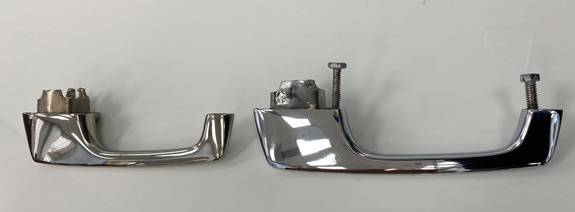
Chrome plating, often referred to as chrome, is a technique consisting of electroplating a thin layer of chromium onto a metal object. The chromed layer can be decorative, provide corrosion resistance, ease cleaning procedures, or increase surface hardness.

Chrome plating is usually applied over bright nickel plating. There are mainly two types of chrome plating:

  • Bright Finish (Show chrome);
  • Satin Finish (Industrial chrome).


QQ-C-320

TYPE 1 BRIGHT FINISH
TYPE 2 SATIN FINISH
CLASS 1 0.00001


Zinc Nickel

Zinc-Nickel electroplating is an alloy coating deposited from an acid solution that is used for the protection of steel, cast iron, malleable iron, copper, and brass. Zinc-Nickel can also replace cadmium in galvanic interaction applications where the coating is intended to minimize corrosion caused by the interaction of dissimilar metals. The typically thickness varies from 0.0003” to 0.0005”.

Plating Thickness: Ranges from 0.0001 to 0.0012 inches.

Corrosion protection: As a true alloy, Zn-Ni coatings are proven to provide two to three times more corrosion-resistant protection than zinc-only coatings. On the Vickers hardness scale, parts coated with Zn-Ni reach 450, compared to less than 150 for zinc-coated parts.

ASTM B841

CLASS 1 DEPOSITING MIN 5 AND MAX 12% OF NICKEL, BALANCE BEING ZINC
TYPE A WITH COLOURLESS(BRIGHT BLUE)CONV. COAT
TYPE B WITH YELLOW IRIDESCENT CONVERSION COAT
TYPE C WITH BRONZE CONVERSION COATING
TYPE D WITH BLACK CHROMATE CONVERSION COATING
TYPE E ANY OF ABOVE PLUS ORGANIC TOP COAT

TIN

Tin plating can produce an Off-White (whitish-gray) color that is preferable when a dull/matte or bright appearance is desired. Tin plating can offer a Bright metallic look when a bit more lustre is preferred and it can also create a Matte (dull) finish, if required. Tin offers a decent level of conductivity, making tin plating useful in the manufacturing of various electronic components.

MIL-T-10727

TYPE 1 ELECTRO DEPOSITED
GRADE B 0.0001″-0.00025″
GRADE C 0.0002″-0.0004″
GRADE D 0.0003″
GRADE E 0.0002″-0.0006″

ASTM B 545

CLASS A 0.0001″(MILD SERVICE)
CLASS B 0.0002″
CLASS C 0.0003″-0.0004″
CLASS D 0.0006″-.0008″
CLASS E 0.0012″
CLASS F 0.00006″.

SILVER

Silver lends itself well to electroplating due to its unique properties, which are unlike many other metals. Clients have used this material for years across numerous industries — and for a good reason. The material’s defining characteristics combine to create a metal that is durable, affordable and hardier than the rest when operating within diverse industrial applications. If you are looking for a cost-effective plating solution, silver is a top choice. By emphasizing quality and function, this metal has earned a valuable space among popular metals used for plating.

QQ-S-365 REV D

0.0005″ INLESS OTHERWISE SPECIFIED.

TYPE 1 MATTE TYPE 2 SEMI BRIGHT TYPE 3 BRIGHT GRADE WITH CHROMATE GRADE WITHOUT CHROMATE

ASTM B 700

TYPE 1 >99.9% PURE
TYPE 2 >99.0 PURE
TYPE 3 >98% PURE
GRADE A MATTE
GRADE B BRIGHT
GRADE C GRADE A COATING CHEM/MECH.
GRADE D SEMIBRIGHT
CLASS N WITHOUT CHROMATE TREAT
CLASS S WITH CHROMATE.