All posts by gadmin

DECORATIVE / INDUSTRIAL CHROME

Chrome plating, often referred to as chrome, is a technique consisting of electroplating a thin layer of chromium onto a metal object. The chromed layer can be decorative, provide corrosion resistance, ease cleaning procedures, or increase surface hardness.

Chrome plating is usually applied over bright nickel plating. There are mainly two types of chrome plating:

  • Bright Finish (Show chrome);
  • Satin Finish (Industrial chrome).


QQ-C-320

TYPE 1 BRIGHT FINISH
TYPE 2 SATIN FINISH
CLASS 1 0.00001


Zinc Nickel

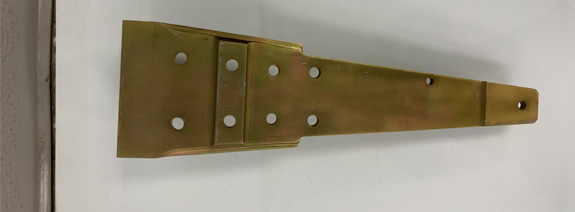
Zinc-Nickel electroplating is an alloy coating deposited from an acid solution that is used for the protection of steel, cast iron, malleable iron, copper, and brass. Zinc-Nickel can also replace cadmium in galvanic interaction applications where the coating is intended to minimize corrosion caused by the interaction of dissimilar metals. The typically thickness varies from 0.0003” to 0.0005”.

Plating Thickness: Ranges from 0.0001 to 0.0012 inches.

Corrosion protection: As a true alloy, Zn-Ni coatings are proven to provide two to three times more corrosion-resistant protection than zinc-only coatings. On the Vickers hardness scale, parts coated with Zn-Ni reach 450, compared to less than 150 for zinc-coated parts.

ASTM B841

CLASS 1 DEPOSITING MIN 5 AND MAX 12% OF NICKEL, BALANCE BEING ZINC
TYPE A WITH COLOURLESS(BRIGHT BLUE)CONV. COAT
TYPE B WITH YELLOW IRIDESCENT CONVERSION COAT
TYPE C WITH BRONZE CONVERSION COATING
TYPE D WITH BLACK CHROMATE CONVERSION COATING
TYPE E ANY OF ABOVE PLUS ORGANIC TOP COAT

TIN

Tin plating can produce an Off-White (whitish-gray) color that is preferable when a dull/matte or bright appearance is desired. Tin plating can offer a Bright metallic look when a bit more lustre is preferred and it can also create a Matte (dull) finish, if required. Tin offers a decent level of conductivity, making tin plating useful in the manufacturing of various electronic components.

MIL-T-10727

TYPE 1 ELECTRO DEPOSITED
GRADE B 0.0001″-0.00025″
GRADE C 0.0002″-0.0004″
GRADE D 0.0003″
GRADE E 0.0002″-0.0006″

ASTM B 545

CLASS A 0.0001″(MILD SERVICE)
CLASS B 0.0002″
CLASS C 0.0003″-0.0004″
CLASS D 0.0006″-.0008″
CLASS E 0.0012″
CLASS F 0.00006″.

SILVER

Silver lends itself well to electroplating due to its unique properties, which are unlike many other metals. Clients have used this material for years across numerous industries — and for a good reason. The material’s defining characteristics combine to create a metal that is durable, affordable and hardier than the rest when operating within diverse industrial applications. If you are looking for a cost-effective plating solution, silver is a top choice. By emphasizing quality and function, this metal has earned a valuable space among popular metals used for plating.

QQ-S-365 REV D

0.0005″ INLESS OTHERWISE SPECIFIED.

TYPE 1 MATTE TYPE 2 SEMI BRIGHT TYPE 3 BRIGHT GRADE WITH CHROMATE GRADE WITHOUT CHROMATE

ASTM B 700

TYPE 1 >99.9% PURE
TYPE 2 >99.0 PURE
TYPE 3 >98% PURE
GRADE A MATTE
GRADE B BRIGHT
GRADE C GRADE A COATING CHEM/MECH.
GRADE D SEMIBRIGHT
CLASS N WITHOUT CHROMATE TREAT
CLASS S WITH CHROMATE.

ELECTROLESS NICKEL

Electro-less nickel plating is a chemical process that deposits an even layer of nickel phosphorus alloy on the surface of a solid substrate (metal). The process involves dipping the substrate in a water solution containing nickel salt and a phosphorus-containing reducing agent. Electro-less nickel plating is a process that requires depositing a nickel alloy from aqueous solutions onto a substrate without the use of electric current. Therefore, it differs from electroplating which depends on an external source of direct current to reduce nickel ions in the electrolyte to nickel metal on the substrate. Electro-less nickel plating is a chemical process which reduces nickel ions in a solution to nickel metal by chemical reduction.

MIL- C-26074

CLASS 1 NO HEAT TREATMENT
CLASS 2 HT FOR HARDNESS
CLASS 3 NON-HT ALUMINUM ALLOYS
CLASS 4 HT ALUMINUM
GRADE A 0.001″
GRADE B 0.0005″
GRADE C 0.0015″

ASTM B733

TYPE I ANY PHOSPHORUS
TYPE II 1-3%P
TYPE III 2-4%P
TYPE IV 5-9%P
TYPE V >10%P
SC0 0.000004″MIN THICKNESS
SC1 0.0002″
SC2 0.0005″
SC3 0.001″
SC4 0.003″

PHOSPHATE

Zinc phosphate coating is formed througha process of crystallization on the surface by a chemical reaction. The Zinc phosphate process should be applied by immersion, and it can be used for any phosphate application.

Manganese phosphate phosphate is used both for corrosion resistance and lubricity. It is applied by immersion.

MIL-P-16232

TYPE Z ZINC PHOSPHATE
TYPE M MANGANESE PHOSPHATE

CADMIUM

Electroplated cadmium is a robust and versatile metallic coating. Cadmium is a soft white metal that, when plated onto steel, cast iron, malleable iron, copper, and powdered metal, functions as a “sacrificial coating,” corroding before the substrate material. Cadmium plated surfaces resist mold or bacteria growth. The typical thickness of cadmium ranges from .0002to.0008 inches. Typical chromates applied include Clear, Yellow, Olive Drab and Black.

QQ-P-416

TYPE 1 AS PLATED (CLEAR)
TYPE 2 WITH CHROMATE TREAT (YELLOW)
TYPE 3 CLEAR WITH PHOSPHATE
CLASS 1 0.0005″ MIN
CLASS 2 0.0003″MIN
CLASS 3 0.0002″MIN

ASTM B766

TYPE 1 AS PLATED
TYPE 2 WITH COLOURED CHROMATE(YELLOW)
TYPE 3 WITH CLEAR CHROMATE
CLASS 25 0.001″
CLASS 12 0.0005″
CLASS 8 0.0003″
CLASS 5 0.0002″

Black oxide

Black oxide or blackening is a conversion coating for ferrous materials, stainless steel, copper and copper based alloys. It is used to add mild corrosion resistance, to enhance appearance and to minimize light reflection. To achieve maximal corrosion resistance, the black oxide must be impregnated with oil or wax. One of its advantages, over other coating processes, is its minimal build-up.

MIL-DTL-13924

CLASS 1 IRON ALLOY STEEL
CLASS 2 TEMPERED MATERIAL
CLASS 3 SALT TEMPERED
CLASS 4 OTHER STEEL ALLOYS

AMS 2485

NO CLASS WITH OIL/TEST WITH OXALIC ACID

Anodizing

Anodizing is an electrochemical process that converts the metal surface into a decorative, durable, corrosion-resistant, anodic oxide finish. Aluminum is ideally suited for anodizing . Anodizing layer is nonconductive also.

MIL-A-8625 RevF

Type 1 Chromic Acid Anodizing
Class 1 Clear
Type 3 Hard Anodizing( Clear/ Black)
Class 1 Clear
Class 2 Black
TYPE 2 SULFURIC ACID
Class 1 CLEAR (NON-DYED)
Class 2 DYED (BLACK, GOLD, RED, BLUE)

PASSIVATION

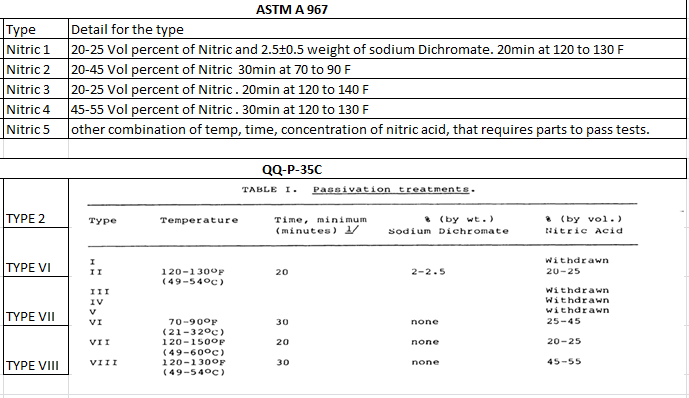
Passivation is the process of treating or coating a metal in order to reduce the chemical reactivity of its surface. On stainless steel, passivation requires removing the free iron from the surface of the metal using an acid solution to prevent rust. Passivation is the final treatment/cleaning process used to remove iron from the surface of corrosion resistant steel parts to insure than a more uniform formation of a passive surface is obtained, thus enhancing corrosion resistance.

Specifications: QQ-P-35C, ASTM A967,or as specified by clientswith specific requirements.